
Reviewed by:
Our Dermatology Editorial Team
Last Updated:
June 2026

If you've spent years buying firming creams, body lotions, and "collagen-boosting" serums for crepey skin — and seen very little change — you're not imagining things.
Those products weren't failing because of bad ingredients. They were failing because they can't physically reach the layer of skin where crepey texture originates.
Crepey skin isn't a surface problem. It's a structural one. The tissue-paper texture, the fine wrinkling on your arms and neck, the skin that no longer bounces back — that happens in the dermis, several layers below where any topical cream can penetrate.
This guide explains exactly what does reach that layer, and what you can realistically expect after your first treatment, your third, and your sixth.
This guide is for you if:
You're dealing with crepey, loose, or tissue-thin skin on your arms, neck, chest, or under-eyes — and you want to understand what actually works, backed by the biology, before spending another dollar on something that sits on the surface.
Crepey skin — that thin, finely wrinkled texture that resembles tissue paper — is caused by one core problem: the breakdown of collagen and elastin, the structural proteins that keep skin firm, thick, and resilient.
After your mid-30s, collagen production drops by roughly 1% per year. Elastin becomes brittle. UV exposure accelerates both processes dramatically.

The result: skin on the arms, neck, chest, and under-eyes loses its bounce and begins to crinkle. But here's what most product marketing doesn't tell you: collagen and elastin are produced in the dermis — a layer 1–2mm below the skin's surface.
The skin's outer barrier (the stratum corneum) is specifically designed to keep things out. No matter how powerful the active ingredients in a topical cream, they cannot cross that barrier in meaningful concentrations. This is why years of firming lotions produce hydration but not structure.
"The skin's barrier is remarkably effective — which is why crepey skin doesn't respond to topicals the way people hope. You need a delivery method that bypasses it. That's exactly what micro-infusion does."
— Board-Certified Dermatologist, reviewed for Qure Skincare
Micro-infusion solves this directly. By creating thousands of controlled micro-channels in the skin's surface, it temporarily bypasses the barrier — triggering the body's natural wound-healing response (new collagen and elastin) while simultaneously delivering clinically formulated serums to the dermis at a concentration topical application can never achieve.
The remodeling phase is where crepey skin actually improves. Each treatment restarts the cycle.
Treat every two weeks, and you're creating a continuous collagen-stimulating environment that compounds over time — the same principle behind in-clinic micro-infusion, at a fraction of the cost.
Based on the healing biology above and user data from thousands of Qure treatments, here's what to realistically expect at each stage for crepey skin.

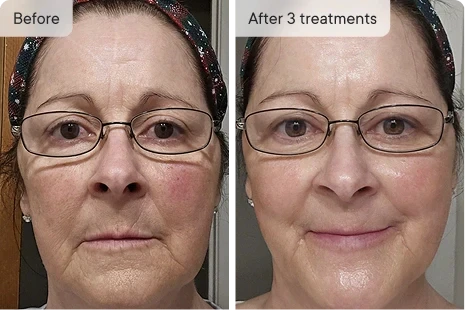
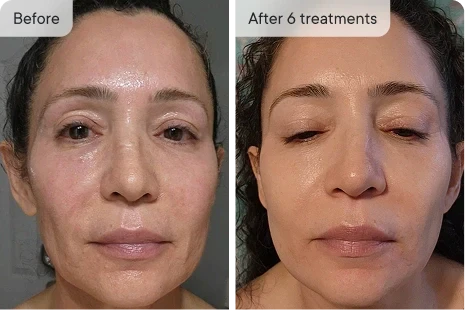
Ready to start your crepey skin treatment timeline?
Subscribe and never run out mid-treatment cycle.

It's not the device. It's not the serum. It's inconsistency.
Collagen remodeling is a continuous process that requires sustained stimulation. A 4-week gap in treatments doesn't just pause progress — it effectively resets the active remodeling phase.
Your skin doesn't "remember" where it left off. This is why so many people try microneedling twice, see no dramatic overnight change, and give up — right before the structural changes would have appeared.
The compound effect is real:
Users who complete 6 consecutive biweekly treatments report results 4× more significant than those who do 6 treatments sporadically over 6 months. Timing matters as much as the treatment itself.
The practical barrier is supply. Running out of clinically formulated serum — and waiting days to reorder — breaks the cycle at the worst possible moment. Auto-ship subscription is the simplest way to protect your progress.
The micro-channels created during treatment are open and actively absorbing for 20–30 minutes after each session.
What you apply during that window penetrates to a depth and concentration that normal topical application can never achieve. Active ingredients reach the dermis — where collagen is produced — rather than sitting on the surface.
For crepey skin specifically, the most effective active ingredients are those that stimulate collagen and elastin synthesis at the dermal level. Qure's serums are formulated specifically for this delivery window:
Crepey texture, laxity
Dark Spots & Uneven Tone
Both concerns
Copper Peptide GHK-Cu, Beta Glucan, Sodium Hyaluronate
EGF, Niacinamide, Tranexamic Acid
Mixed serum system
Stimulates collagen & elastin synthesis, deep hydration to restore plumpness
Accelerates cell turnover, inhibits melanin transfer, brightens
Combined collagen, brightening, and barrier-repair action
Given everything above — that crepey skin originates in the dermis, that topicals can't cross the skin barrier in meaningful concentrations, and that collagen remodeling requires sustained stimulation — the treatment approach becomes clear.
You need something that bypasses the barrier, delivers actives to the right depth, and can be done consistently enough to compound results over time.
That's precisely what at-home micro-infusion does. And done correctly, it mirrors the mechanism of in-clinic micro-infusion at a fraction of the cost.


Why stamping — not rolling:
Derma rollers drag the needle laterally across skin, causing micro-tears that are especially damaging to the thinner, more fragile skin of crepey areas. Stamping delivers a clean, vertical channel with no lateral movement — more precise delivery, less irritation, safer on delicate skin.


For treating crepey skin at home, the product needs to clear three bars: the right needle depth and quality to create effective micro-channels without damaging delicate skin, a serum formulated specifically for dermal collagen and elastin rebuilding, and a consistency model that ensures you don't break the remodeling cycle.
The Qure Micro-Infusion System is the product that clears all three.
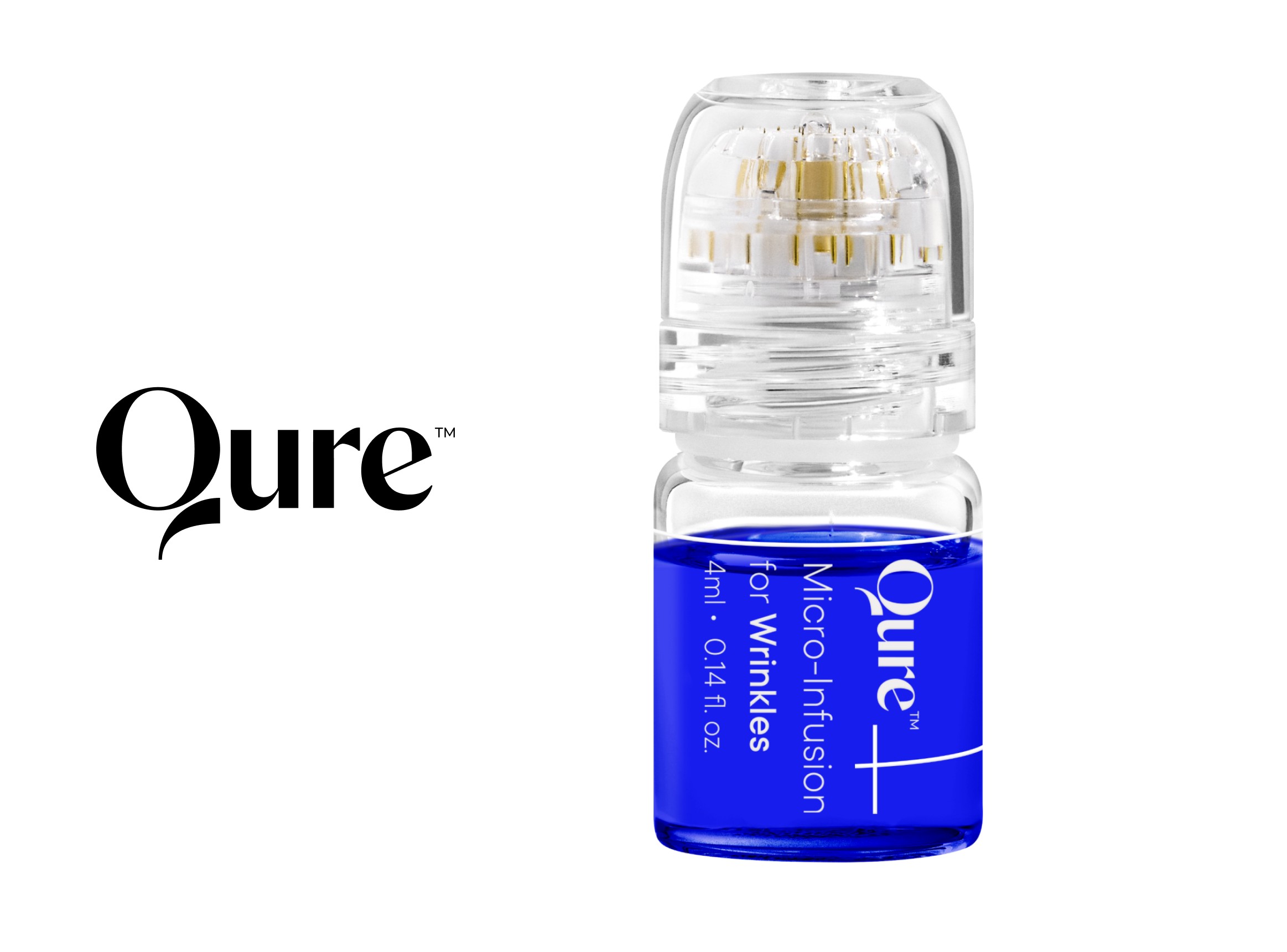
The hardware gets you to the dermis. What you deliver there determines the result. Qure's Wrinkles Serum is the formulation specifically designed for crepey skin laxity:

"I love that Qure Skincare products go beyond just topical treatments, helping to maintain the results of in-office procedures."
— Dr. Tripathi, Double Board Certified Facial Plastic Surgeon

"The Qure Micro-Infusion stamping device offers a safe and effective solution for a variety of different skin conditions."
— Dr. Stephens, Board Certified Dermatologist
CLINIC TREATMENT
$300+
per session
AT HOME
$18
per treatment
$218 / 6-month kit (12 treatments)
The same mechanism. The same collagen stimulation cascade. At home, on your schedule, without clinic appointments.
Limited-Time Offer
Your Skin Responds to Consistency. Make It Easy.
Auto-ship means you never run out mid-cycle. Cancel anytime. 90-day money-back guarantee.
What Real Users Say After Treating Crepey Skin
Frequently Asked Questions
Try It Risk-Free for 90 Days.
One clinic micro-infusion session costs $300+. A full 6-month kit at home — 12 treatments — is $218. If you don't see visible improvement after 90 days of consistent use, Qure will refund you in full. No fine print.
